ZZ Krebs
@ Other Places Art Fair
September 27th, 2025 from 11am - 6pm
Spore Space is pleased to present work by artist ZZ Krebs at our booth at Other Places Art Fair this year.
Krebs’s practice spans sculpture, installation, and drawing, and is rooted in both research and a generational lineage of stone carving. This body of work, a collection of pieces created over the past five years, explores cycles of transformation, geological time, and the quiet but constant presence of impermanence in human life.
Stone is central to Krebs’s work: as monument, as sediment, as memory, and as a vessel for time itself. In her hands, stone doesn’t merely hold form; it carries rich histories, echoes of geological rhythms, and its own vital material life. As Jane Bennett writes in Vibrant Matter: “Even metal is alive—it can crack in interesting ways… the line of travel of these cracks … [is] expressive of an emergent causality.” It is exactly this emergent and unpredictable nature of matter that drives Krebs's work: each piece is a negotiation between the artist, her environment, and the agency of the material itself.
Themes of ecological interdependence, cosmological cycles, and deep time resonate throughout this exhibition. Drawing, sculpture, and installation merge into environments that are immersive and contemplative. And yet, the work remains grounded in the tactile: the weight of stone, the flicker of light, the texture of polished or rough surfaces. These elements don’t seek to resolve or explain themselves, instead creating space for ambiguity, stillness, and presence. Is this a ruin or a beginning? The tension between the two is where the work lives.
Krebs allows materials to speak through metaphor, texture, movement, and form. As Bennett suggests, materials carry their own directionality and decision-making; Krebs listens closely to this. The materials act. The artist responds.
Krebs does not present nature as something to be decoded, but something to be in relation with – responsive, layered, and always in flux. This installation invites viewers to slow down, to pay attention to how things shift, break, and emerge; and finally, to fix that patient lens on their own lives
Written by Kira Doutt
Join us at Other Places Art Fair this year to see the work of ZZ Krebs at the Spore Space booth. This free, annual event is open to the public. OPAF features over thirty booths featuring over 100 participating local, national, and international contemporary artists. Operating outside traditional art systems, Other Places art fair provides a platform for artists of all backgrounds and socioeconomic statuses, creating an inclusive, outdoor space for artistic projects united by the intention to exist in alternative settings.
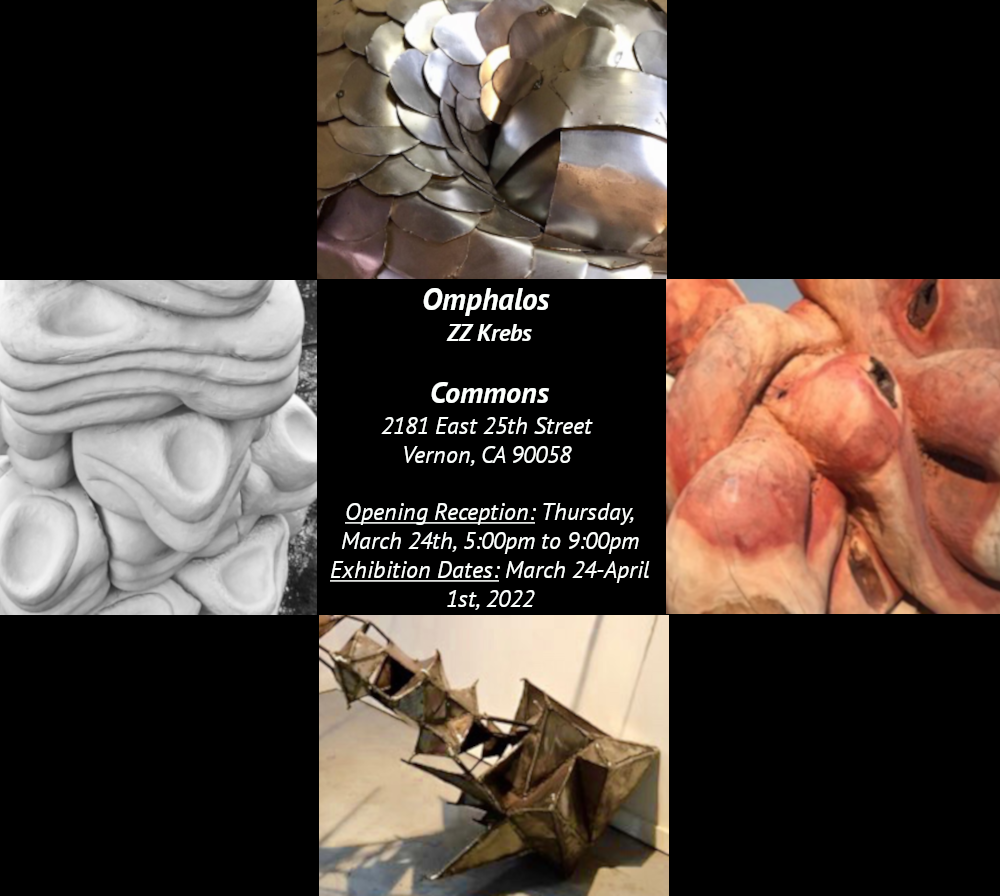
ZZ Kreb’s Omphalos
I’m thinking of warm dinner rolls...Breasts, bellies, and how butter molds into bread...kneading dough and waiting for it to rise. Chiseling produces a layer of white dust, like all-purpose flour, that falls as the limestone takes form. Every tap makes the block of stone become more sensuous, smooth, and milky.
This is Creation.
ZZ Kreb’s stone-carving process employs skills learned from her own mother. Hand-carved limestone in Omphalos reminds me of a joyful woman’s body: laugh lines, wrinkles, folds of fat or skin. The opaque, chalky stone1 is like breast milk or sperm. Nourishing, erotic, life-making.
Omphalos, also “the navel,” is the center2 or origin of the universe in many myths and cosmogonies3. Is the navel not firstly an umbilical cord? A vein providing nourishment that connects a child to its mother?
Stacked stones in Omphalos & bulbous forms, hand-carved out of cedar in Entwined reminds me of Louis Bourgeois’ Torso: Self-Portrait and Camul 1. I recall Melanie Klein’s idea of part-objects,4 which is a psychoanalytic theory often used to describe artworks with body part-like forms. The part-object is based on a child’s understanding of our mother’s breast as a good-object.
“The earth is often seen as a woman's body” wrote Lucy Lippard in Overlay. Can this longing for a mother’s breast also be a longing for a connection to the earth/nature5 and life itself? Kreb’s Diatom, is a hand-carved wooden diatomic structure. The piece displays a soft, sanded surface that is disrupted by multiple holes...even navels. In nature, diatoms provide food to higher organisms6 and are an essential part of the food chain. Similar to breastmilk, they provide nutrients to other life forms.
ZZ Kreb’s Omphalos uses the materials of stone, wood, latex, and steel to reflect upon our connection to time, nature, and the human experience. Each work explores the act of art-making as creation, life-making, and life-sustaining. As such, the show weaves together human and non-human timescales through a use of prehistoric stone, part-object forms, and invented organisms or creatures.
Written by Maya VanderSchuit
1 Limestone, or calcium carbonate, is a sedimentary rock made of fossilized shells and crustaceans. (More here on California State University’s website)
2 “A universe comes to birth from its center; it spreads out from a central point that is, as it were, its navel.” from The Sacred and Profane by Mircea Eliade
3 Cosmogonies is defined by Merriam-Webster as 1) the theory of the origin of the universe 2) the creation or origin of the world or universe. (More here)
4 Melanie Klien created an Objects Relation Theory in 1921 that is a variation of psychoanalytic theory. It is discussed in relation to Louis Bourgeois on Tate Modern’s Website.
5 I am aware of the problematic nature of identifying a woman as nature, as outlined in Shery Ortner’s Is Female to Male as Nature is to Culture (1975). My argument serves to draw connections between the artist, her mother, and the choice of materials and forms.
6 This information is paraphrased from an EPA article titled Indicators, Sediment Diatoms.